Trump targets loyalist states in final push to hold Congress
The president campaigned in Iowa and Kansas while Democrats in Michigan grappled with internal disputes over their Senate candidate.
By Charles Reed ·
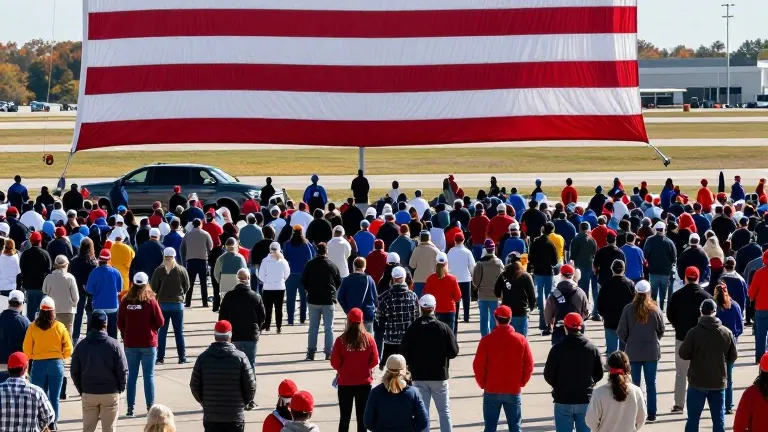
President Donald Trump spent the final days of the midterm campaign rallying in Iowa and Kansas, two states he has won comfortably in the past. These rallies serve as a defensive play for the Republican Party, which faces tough challenges in holding its majorities in both the House and Senate. With more than 54 million votes already cast, the elections have become a direct referendum on the first year of Trump's second term in office.
In Dubuque, Iowa, Trump spoke for two hours on Sunday before moving to Salina, Kansas. In both locations, he told supporters that Republicans were poised for sweeping victories on Tuesday. “We're going to elect ‘America first’ Republicans up and down the line,” he told the crowd in Iowa. The strategy marks a shift from the 2024 presidential race, when Trump focused on flipping states that supported President Joe Biden. This cycle, he has concentrated his efforts on states where his base is solid, even as some voters question the economic impact of his tariffs and the war in Iran.
Meanwhile, Democrats in Michigan faced a sudden fracture in their campaign to retake the Senate. Haley Stevens, who lost to Abdul El-Sayed in the primary, appeared with Republican challenger Mike Rogers at a church service and later endorsed him. Stevens, a congresswoman who had criticized El-Sayed for not supporting Israel enough, announced her switch in a video. She stated that El-Sayed’s campaign told her she was no longer welcome. “Our Democratic nominee for Senate said I was no longer welcome in his campaign and that I should stay away,” Stevens said.
Other Democratic leaders moved quickly to reaffirm their support for El-Sayed. Senate Majority Leader Chuck Schumer of New York said the party remained united in its backing of the Michigan candidate. Senator Kirsten Gillibrand, who leads the Democratic Senatorial Campaign Committee, added that the party would stand firmly behind El-Sayed and reject efforts to divide the ranks. Senator Bernie Sanders of Vermont, a key supporter of El-Sayed, dismissed the notion of a split. He noted that Stevens had lost a close primary and expressed understanding of her frustration, but observed that people across the state were still standing with El-Sayed.
Michigan is a critical battleground for Democrats aiming to regain control of the Senate. If they lose that seat, they will need to win races in deeper red states like Texas, Kansas, Ohio, or Iowa. The pressure on the party is high as the final days of campaigning unfold.
Voters in Trump's home states expressed mixed feelings about the current administration. Jon Lutz, a 60-year-old civil engineer from Dubuque, attended his first Trump rally on Sunday. He said he was happy with the president's record and wanted Republicans to keep Congress to advance the agenda. “He’s done what he’s said he’s going to do,” Lutz said. Wendy Kuenzler, 44, from Burlington, also attended her first rally. She said she did not blame rising gas and grocery prices on Trump, believing he was on the path to correcting them.
In Kansas, Liz Wagner, a 59-year-old restaurant owner from Atchison, traveled 165 miles to attend the rally at the Salina airport. She said she agreed with everything the president said and wanted voters to work harder rather than expect government handouts. “I want people to get up and go to work and stop sticking their hands out,” Wagner said.
Trump’s campaign strategy relies on energizing loyal supporters, but his recent rallies in October have sometimes featured long asides and descriptions of male politicians' physiques. He paused the rally schedule on Saturday for a Halloween party at his Mar-a-Lago resort in Florida, where he told guests the country has never done better.
Republican officials offered differing views on the party's chances. Outgoing Representative Don Bacon of Nebraska warned that tariffs are unpopular in the Midwest and could weigh on GOP results. He predicted a debate within the party if losses are substantial. Senator Tim Scott of South Carolina, chair of the National Republican Senatorial Committee, remained optimistic. He said Trump’s agenda was on the ballot and expressed confidence that Republicans would keep the Senate.
The campaign enters its final stretch with Democrats in Michigan working to hold their base together and Republicans in Iowa and Kansas seeking to lock in their traditional advantages. The outcome will determine whether the party that controls the White House also controls Congress for the next two years.
More Politics · Philadelphia news · Report a business · Got a Story?