
ZEV Mandate Review: UK Weighs £4,000 Credits for Grid-Feeding EV Tech
The proposal allows carmakers to offset petrol car sales with bidirectional charging hardware, a move critics argue overvalues the technology relative to its current adoption rate.
By Charles Reed ·
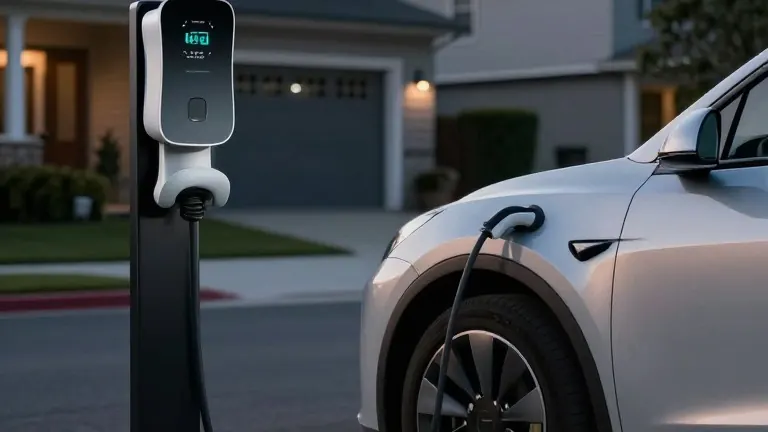
The UK government is considering awarding automotive manufacturers a credit of approximately £4,000 for each electric vehicle equipped with vehicle-to-grid technology. This proposal, detailed in a consultation that closed on Friday, would allow carmakers to sell additional petrol models without facing fines for missing zero-emission vehicle targets. The scheme effectively treats the installation of bidirectional charging hardware as a compliance asset under the current mandate.
Vehicle-to-grid technology enables drivers to automatically charge vehicles during periods of low electricity demand, typically overnight. The system then allows the car to export stored energy back to the grid during peak usage times. Proponents argue this capability could help balance the national grid during periods when wind and solar generation falls below electricity demand, reducing the need to activate expensive gas power plants to fill supply gaps.
The consultation forms part of a broader review of the zero-emission vehicle mandate. The government is preparing to reduce electric vehicle sales targets in the coming years. Environmental groups are anticipating these changes will result in an additional 147 million tonnes of carbon emissions by 2050 if the mandate is loosened. The new credit system would provide a financial mechanism for manufacturers to manage this transition.
Critics from the automotive sector warn that the incentive structure may not reflect actual consumer usage. Ben Nelmes, chief executive of the thinktank New AutoMotive, noted that the technology is promising but should only be rewarded if drivers actively use it. He stated that under the current proposals, manufacturers could earn one or two credits worth around £4,000 each for kit that costs only a few hundred pounds. Nelmes argued that few drivers currently own the expensive chargers required to utilize the feature, suggesting the benefits accrue to shareholders rather than billpayers.
Vicky Edmonds, chief executive of the Electric Vehicle Association England, expressed concern that the credit allows manufacturers to sell fewer electric vehicles for a technology that has not been tested at scale. She pointed out that while millions of drivers own electric vehicles in the UK, only a fraction are currently using vehicle-to-grid or storage technologies. Edmonds said consumers are still focused on immediate concerns such as vehicle cost, charging expenses, and daily usability, making the timing of the credit premature.
Smart charging tariffs already encourage owners to charge when electricity is cheap and abundant, reducing the need to pay renewable generators to switch off. However, these tariffs do not require the specific hardware associated with bidirectional charging. The new proposal specifically targets the ability to export power, a feature that can also power a driver’s home, known as vehicle-to-home technology.
Several companies already facilitate electricity sales to the grid. In the UK, Octopus Energy offers a service where drivers can earn by exporting power. The company claims drivers can save £620 a year through this arrangement. Similar programs exist in France with Renault and in Germany with BMW. These existing services demonstrate the commercial viability of the technology for individual consumers.
The National Energy System Operator, which balances the grid in Great Britain, forecasts the potential impact of widespread adoption. By 2030, electricity supplied by vehicle-to-grid vehicles could reach 1.2 gigawatts, equivalent to the output of a single power station on demand. The operator projects this capacity could grow to 41 gigawatts by 2050. That level of output would be sufficient to meet more than a quarter of peak energy demand in the country.
The government has not yet finalized the rules for the credit system. The consultation period has ended, and officials are reviewing the responses from industry stakeholders and environmental groups. The final decision will determine how bidirectional charging is valued within the zero-emission vehicle framework for the next decade.
Source: The Guardian
More Business · Customer Complaints · Report a business · Got a Story?