Starship Flight: Booster Loss Forces Orbital Return
The first-stage rocket exploded in the Gulf of Mexico, ending the attempt for a dual recovery, while the upper stage continues its 22-hour mission to re-enter over Texas.
By Lucia Herrera ·
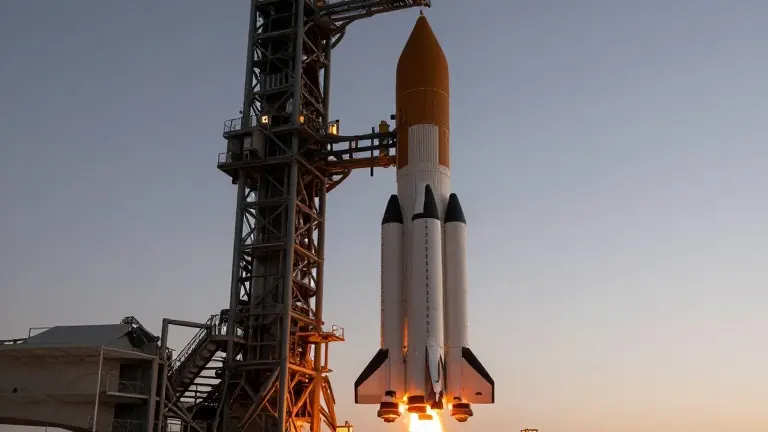
SpaceX’s Starship spacecraft is currently orbiting Earth after its booster stage failed to return to the launch pad and exploded in the Gulf of Mexico on Friday. The loss of the first stage prevented the company from achieving its goal of catching both rocket components simultaneously, a feat never before accomplished in spaceflight. Despite the setback, the upper stage continued its ascent and is now on a trajectory to steer back toward the launch site in Texas for a scheduled re-entry on Saturday.
The flight duration is expected to reach 22 hours. During this time, the spacecraft will complete approximately 15 laps around the globe at an altitude of 170 miles. The vehicle successfully deployed 26 Starlink satellites shortly after reaching orbit. This marks the first attempt to recover the upgraded booster, which stands 236 feet tall, and the spacecraft, which spans 171 feet. Together, these components form the world’s largest and most powerful rocket, reaching a total height of 407 feet.
SpaceX launch commentator Kate Tice acknowledged the unexpected outcome, stating, "Well, that certainly isn’t the news that we had hoped to hear for today." She noted that the decision to divert the booster offshore aligned with rigorous safety protocols designed to protect the launch pad. The company did not provide an immediate explanation for the failure. This incident follows three previous successful booster recoveries at the Starbase facility near the U.S.-Mexico border, making the Friday miss a surprising deviation from recent success.
The primary objective of the full-stack recovery is to enable rapid reuse of all rocket components, a capability necessary for high-frequency launches to the moon and Mars. SpaceX Vice President of Launch Kiko Dontchev emphasized at a recent NASA summit that full reusability is the key to scaling launch rates from a few per year to potentially 100,000 over time. He distinguished Starship from the company’s Falcon rockets, which still discard their second stage on every flight.
NASA Administrator Jared Isaacman responded to the orbital success via X, expressing anticipation for utilizing Starlink capabilities during the Artemis III mission. That mission, planned for next summer, will involve astronauts practicing docking maneuvers with both a Blue Origin capsule and a Starship in Earth orbit. These rehearsals will prepare for the Artemis IV lunar landing, where NASA expects to decide whether to use Starship or Blue Origin’s Blue Moon lander to deliver astronauts to the moon's surface.
SpaceX plans to begin launching Starships from Florida within the next few months and from Louisiana in a few years. The company intends to eventually replace its Falcon fleet with Starships for satellite deployment and crew transport. Until then, Falcon rockets will continue to carry astronauts to the International Station from Cape Canaveral and Starlink satellites from California.