Gaza Cinema Academy: Women filmmakers premiere five documentaries
A new film school launched in the Strip as women screen works made during the war, addressing issues from hunger to disability.
By Mei Lin ·
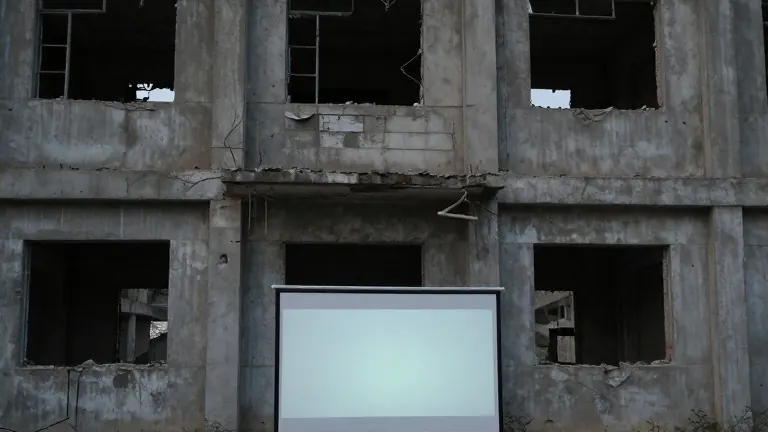
Mona Abu Qass screened her 11-minute documentary, A Sack of Flour, at the opening of the second Gaza International Women’s Film Festival. The film examines how Israel used starvation against Palestinians during the war. It draws on Abu Qass’s personal experiences to show the struggle to find food in the Gaza Strip.
The festival opened on Monday at the site of al-Nakheel Hall in al-Bureij. The hall is destroyed, like most buildings in Gaza, following three years of war that have killed more than 74,000 Palestinians. The event ran under the slogan “Women Creating Life from Death.”
Four other documentaries by Palestinian women were also shown. Raghda al-Buhaisi presented Beyond Silence, a film about the wartime struggles of people with disabilities. It follows a deaf artist in Rafah who never learned sign language. His studio was destroyed, and several family members were killed. He was later taken in by another family in Deir el-Balah.
Al-Buhaisi said she wanted to show the extra challenges people with disabilities face during war. These include displacement and the loss of livelihoods. She noted that art can turn individual pain into a visual message for the world.
The festival also screened three other films: Soso: The Lifeline, Remnants of Light, and Dandana. Soso: The Lifeline follows an orphaned child and his donkey who help people survive. Remnants of Light documents a filmmaker dealing with the loss of her family and home. Dandana tells the story of a mother whose eight children were killed. She uses Palestinian songs to cope with her grief.
The five documentaries were produced through a filmmaking diploma program that started in March. The program brought together 25 young Palestinian women. Festival director Ezzedine Shallah said the films offer visual testimony to daily life. He stated that they preserve stories that might otherwise never reach a screen.
The festival runs until October 31 and features 73 films from 24 countries. It aims to provide a platform for filmmakers from Gaza and other regions. However, making films in Gaza remains difficult. Cultural institutions are destroyed, and equipment is scarce. Filmmakers also face limited funding, power outages, and internet issues.
Rima Mahmoud, a co-founder of the festival, said the war and the siege on Gaza have hindered young women in filmmaking. Some have had to self-fund projects and use simple methods. She said these films deserve international exposure and need technical and financial support.
Mai Masri, a Palestinian filmmaker based in Lebanon and another co-founder, said the films help young women resist erasure. The new Gaza Cinema Academy, which launched with the festival, has developed a filmmaking diploma. It works with al-Quds Open University and is accredited by the Palestinian Ministry of Education. Masri said the academy is seeking agreements with distributors to screen these films in educational institutions and international festivals.