Strait of Hormuz Traffic Drops 65% Amid US Strikes on Qeshm
Iran lifted its ballistic missile range cap as mediators in the Middle East attempted to prevent the conflict from expanding.
By Lucia Herrera ·
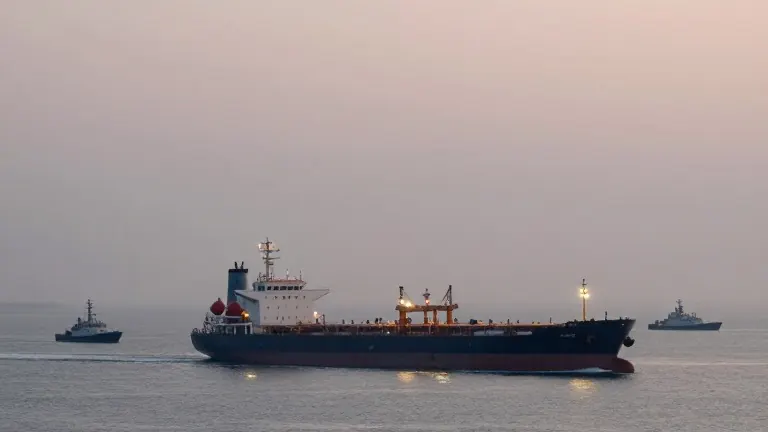
Shippers moving oil through the Strait of Hormuz faced a sharp reduction in traffic last week as hostilities between the United States and Iran continued. The United Kingdom Maritime Trade Operations recorded 170 outbound and 155 inbound transits during the week ending November 6. This volume represents a 65 percent decline compared to pre-conflict levels.
The drop in traffic coincided with a series of attacks on maritime infrastructure. At least 11 vessels were targeted in and around the strait during that same week, with three sinking, according to the UK Maritime Trade Operations. The agency noted that 88 projectile strikes have been recorded since hostilities resumed in early July, stating that most attacks likely go unreported. Iran's navy reported on Saturday that a tanker with its transponder turned off caught fire in the eastern strait after striking a mine.
US military operations shifted to land-based targets on Friday night, when two projectiles struck Iran's southern island of Qeshm. President Donald Trump characterized the event as "minor strikes," describing them as the latest action in weeks of attacks on the island's air defenses and launchers. In response to the aerial activity, Iran's army announced early Saturday that it destroyed a US-made MQ-9 drone using a new, unnamed system. The Islamic Revolutionary Guard Corps also claimed its defenses intercepted an MQ-1 drone on Friday, marking the 16th aircraft of that model downed since the war began.
Iran also adjusted its strategic military posture on Saturday. Hossein Mohebbi, a spokesman for the Revolutionary Guard, told reporters that the corps dropped its self-imposed limit of approximately 2,000 kilometers on ballistic missile range. This restriction had been maintained for years to reassure European nations. Mohebbi said, "This limitation has been lifted for us," following an order from Supreme Leader Mojtaba Khamenei for an unrestrained military response to future threats from Israel and the US. Trump has threatened to resume extensive strikes on Iran's civilian infrastructure.
Diplomatic efforts have intensified in recent weeks with limited gains. Foreign Minister Abbas Araghchi stated on Saturday that he spoke with 12 foreign ministers within 48 hours. These conversations included diplomats from Oman, Qatar, Saudi Arabia, and Pakistan, where Araghchi outlined Tehran's seven demands to reopen the strait. He emphasized the need for regional security arrangements that do not involve the interference of superregional powers. Security chief Mohsen Rezaei reportedly delivered the same conditions to Russian President Vladimir Putin in Moscow on Thursday, along with a message from Khamenei.
Analysts suggest the diplomatic window may be narrowing. Mostafa Najafi, a political analyst close to Iran's security chief, described the current situation as a constant swing between war and negotiations that is tilting toward conflict. He noted that the defeat of Trump and the Republicans in the US midterm elections this week could complicate the strategic picture. Trita Parsi of the Quincy Institute identified three factors raising the short-term risk of war: the political cost of high fuel prices has already been absorbed, pro-war hawks will press harder before Democrats take control of Congress in early January, and the appointment of Stephen Miller as chief of staff suggests a readiness to continue the conflict.
Parsi added that a new psychological element has emerged in Trump's mindset following recent events. "Trump's desire for vengeance," Parsi said, is now a factor in the decision-making process. On state television, Iranian analysts warned that their military information regarding Israel's strategic chokepoints is complete. One analyst stated that if Iran's water, electricity, and natural gas supplies are cut off, Israel will also face darkness and a lack of water, calling the threat a serious warning rather than a bluff.