Raymond Smith's NC-3 win exposes GOP map failure
North Carolina legislative Republicans intended the new district lines to secure two seats, but the 2026 results flipped both to Democratic control.
By Charles Reed ·
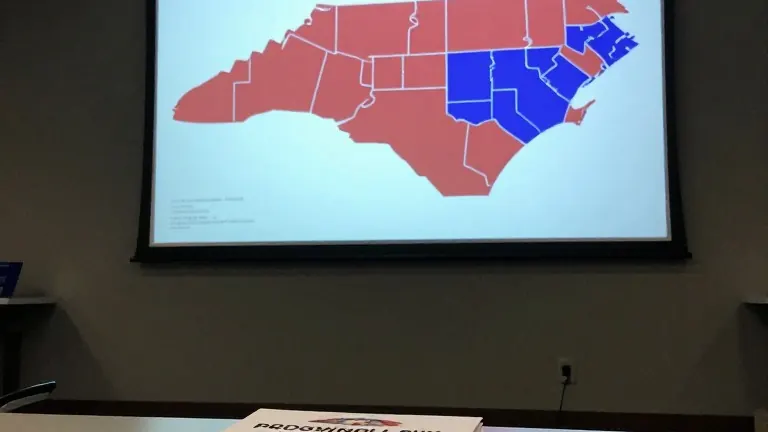
North Carolina legislative Republicans presented a new congressional map last October with a specific goal: to secure two Republican victories in the state's eastern districts. The 2026 election results delivered the opposite outcome, handing both seats to Democrats and creating what political scientists call a dummymander.
Sen. Ralph Hise, R-Mitchell, told the Senate Elections Committee on October 20 that the map was designed to elect 11 Republicans. The district lines moved six counties from the 3rd Congressional District to the 1st, while four counties moved in the opposite direction. The intent was to strengthen the Republican advantage in the 1st District and hold the neighboring 3rd District.
The plan backfired on election night and in the days that followed. Republican incumbent Greg Murphy led the race for the 3rd District after November 4 and declared victory in the early morning hours. That lead evaporated as provisional ballots were counted. Democrat Raymond Smith flipped the district, and Murphy conceded on Wednesday morning. Smith trails Murphy by a margin of 293 votes after the provisional count.
The shift was driven by the counties moved into the 3rd District. Smith won those four counties by 2,532 votes, with Wilson County providing a large portion of that margin. In the 1st District, Republican challenger Laurie Buckhout won the six counties moved into that district by 18,023 votes. This margin far exceeded the margin by which Smith won the 3rd District, indicating that the redistricting moved voters in a way that did not match the original prediction.
Chris Cooper, director of the Haire Institute for Public Policy at Western Carolina University, described the outcome as a textbook example of a dummymander. The term was coined by political scientists Bernard Grofman and Thomas L. Brunell in 2005 to describe redistricting efforts that favor the opponent. Cooper noted that the 2025 map changes only affected the 1st and 3rd Districts, making the failure isolated and clear.
Cooper suggested that the 2024 presidential election served as the high-water mark for Republican performance. Mapmakers relied on 2024 data to draw the lines, assuming that trend would continue. In the 1st District, Trump's projected win increased from 51% to 55%. In the 3rd District, it decreased from 60% to 56%. Cooper argued that these changes would have been effective in most years, but not in a national environment that strongly favored Democrats.
Doug Heye, a former Republican National Committee spokesman, pointed to President Donald Trump's low approval ratings as a key factor. The final Elon University Poll before the election showed Trump approval at 34% and disapproval at 57%. Heye said that if Trump's approval had been higher, incumbents like Murphy would likely have won. The low approval rating made Republican incumbents vulnerable across the state.
Democratic Party chairwoman Anderson Clayton said the party relied on grassroots organizing because they expected less national funding for the 3rd District. AdImpact data shows that Republican-aligned groups spent $1.46 million on TV and digital ads in the race. Democratic-aligned groups spent about $285,000, with Smith's own campaign spending $7,561. Clayton emphasized that the campaign had to work harder to energize voters in districts that were not targeted for major national support.
The Wikipedia page for dummymandering was updated on Wednesday to feature the North Carolina 2024 and 2026 maps as its lead image. Democratic Rep. Deborah Ross posted on social media that the state had become the encyclopedia example of the term. The update occurred hours after Smith took the lead in the 3rd District race.
Smith is a former two-term member of the North Carolina House of Representatives who previously ran for the state Senate and for Goldsboro mayor. Clayton said his experience and personal connections in Wayne County helped him connect with voters. She observed that his ability to meet voters individually was a factor in his victory.
Cooper cautioned that the 2026 result may be an outlier. He predicted that the structural advantage built into the map could help Republicans win the 1st and 3rd Districts, along with six other seats, in 2028. Heye noted that the 2026 blue wave provided incoming Democrats with incumbency and other resources, including a U.S. Senate seat and the governor's mansion, which will aid their re-election efforts.