
Nobel Physics Prize: Drexel physicists named in IceCube Observatory award
Dr. Francis Halzen received the October 6 award for detecting high-energy neutrinos, a project involving Drexel researchers Dr. Naoko Kurahashi Neilson and Dr. Christina Love.
By Mei Lin ·
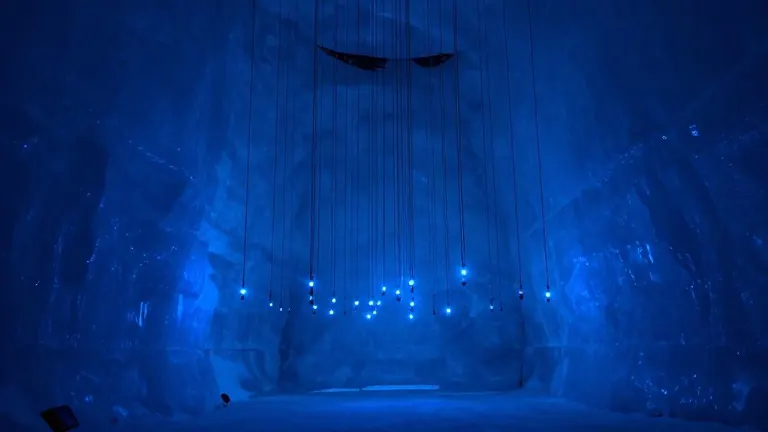
The Royal Swedish Academy of Sciences awarded the 2026 Nobel Prize in Physics to Dr. Francis Halzen on October 6. The citation recognized his decisive contributions to the IceCube Neutrino Observatory and the discovery of high-energy neutrinos of astrophysical origin. Two members of the Drexel University Department of Physics were part of the IceCube team. They are Dr. Naoko Kurahashi Neilson and Dr. Christina Love.
Halzen founded the IceCube Observatory in 2010. The facility is located deep under the South Pole. Its detectors do not capture neutrinos directly. Instead, they sense the reaction when neutrinos interact with water molecules in the ice. That interaction creates a sonic boom that gives off a blue glow. Dr. Brian Greene, a science communicator, explained that the detectors are built to see that specific glow.
The research focus addresses a major challenge in particle physics. Neutrinos have a light mass, making them difficult to track. Halzen and his team targeted high-energy neutrinos of astronomical origin. These particles are among the few in the universe that provide enough detail to determine their source location.
Drexel researchers contributed directly to the work cited in the Nobel award. Kurahashi Neilson stated that papers published by Drexel students and postdocs were included in the citations. She noted that her group's work justifies the recognition for Halzen. "It's very special to see the papers that students and postdocs at Drexel published in the citations as the reason for the Nobel," Kurahashi Neilson said. She added that the award shows the caliber of research possible at Drexel.
Halzen has a prior connection to the university. He spoke at Drexel in 2018 as part of the Kaczmarczik Lecture series. That annual science lecture features award-winning scientists. Halzen was the first guest to receive a Nobel Prize after speaking at the event. Kurahashi Neilson described the award as a big milestone for the team's work. "The recognition is special, and Francis' vision and leadership got us this beautiful detector we all get to work on," she said.
The IceCube team is currently expanding its capabilities. Dr. Christina Love stated that the group recently completed the IceCube Upgrade. This involved deploying five new strings into the ice. The upgrade increases sensitivity to particle physics measurements. The team is looking toward IceCube-Gen2. That project will further expand the detector and its scientific reach. It aims to carry Halzen's vision into the next generation of neutrino science.
The Nobel Prize in Physics is presented by the Royal Swedish Academy of Sciences. The award recognizes contributions that have conferred the greatest benefit to humankind. Halzen's work on the IceCube Neutrino Observatory met that standard for the 2026 cycle. The Drexel connection highlights the collaborative nature of the research. Students and postdocs at the university played a role in the specific discoveries cited by the committee.